
Prompts Are Tiny Plans
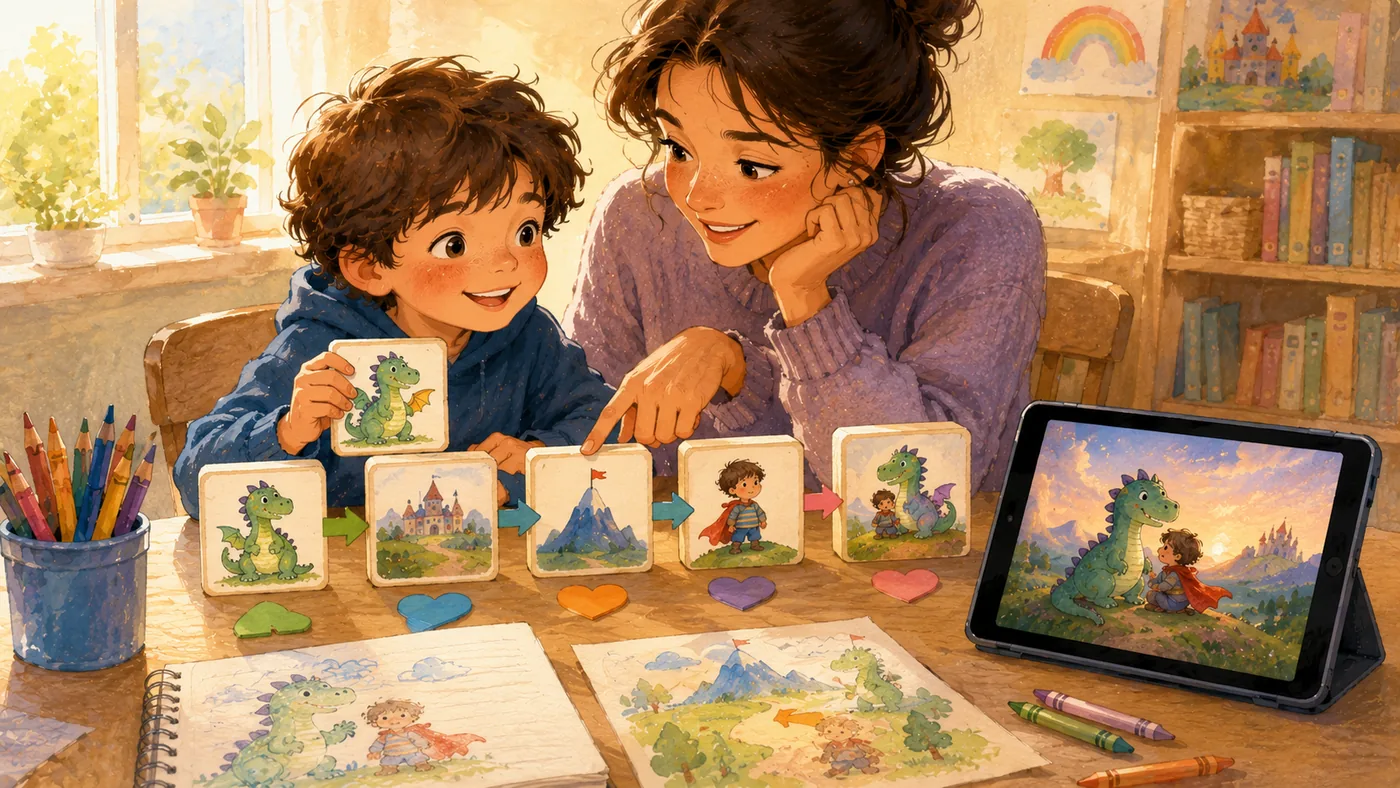
An ai story generator based on prompt can help children learn more than storytelling. It can help them learn how to communicate an idea clearly. A prompt is a tiny plan. It says who the story is about, what the character wants, where the action happens, and what kind of feeling the story should have.
For adults, prompting may sound like a technical skill. For children, it can become a playful thinking activity. TaleHug is useful because it can take a simple family prompt and turn it into a visual storybook, making the results of clear or unclear instructions easy to see.
When the story matches the child's idea, the child learns that details matter. When the story misses something, the child learns to revise the prompt.
From "A Dog Story" to a Better Idea
Children often begin with broad prompts: "Make a dog story." That is a valid beginning, but it leaves many choices open. TaleHug gives parents a reason to ask gentle follow-up questions:
- What kind of dog?
- Where does the dog live?
- What does the dog want?
- Is the story funny, brave, sleepy, or surprising?
- What should happen at the end?
Now the child has a stronger prompt: "A small brown dog named Momo wants to find the moon because it looks like a biscuit. The story should be funny and end with Momo sharing real biscuits with a friend."
This prompt is still childlike, but it has shape. It contains character, goal, mood, and ending. TaleHug can then create a story that more closely reflects the child's intention.
Prompting Builds Observation
Good prompts require observation. If a child wants a character to stay consistent, the child must describe the character: red scarf, blue shoes, curly tail, silver backpack. If the child wants a setting to feel calm, the child must notice what calm looks like: warm light, soft blanket, quiet room, slow rain.
This kind of description builds vocabulary and attention. TaleHug's visual output makes the lesson immediate. If the generated page shows the wrong color or mood, the adult can ask, "What detail should we add next time?"
The child learns to connect words with visual results. That is a practical literacy skill.
Questions Are Part of Creativity
Some children believe creativity means having an instant perfect idea. Prompt-based story creation teaches a healthier lesson: creative people ask questions. TaleHug can support this by making question-asking part of the family workflow.
Before generating a story, parents can guide children through a simple prompt checklist:
- Who is the main character?
- What is the character trying to do?
- What small problem appears?
- Who helps?
- What does the character learn?
- What should the last picture feel like?
These questions build planning skills without making the activity feel like schoolwork. The child is still making a dragon, a moon train, or a talking lunchbox. But underneath the play, the child is practicing structure.
Revision Without Shame
One of TaleHug's strongest educational benefits is that it can make revision feel normal. If the first story draft is not right, the family can improve the prompt. The adult can say, "The story made the robot too loud. What should we tell it?" The child might answer, "Make the robot gentle and shy."
That small revision teaches precision. It also teaches resilience. The first version did not fail. It gave the family information.
This is a valuable mindset for writing, drawing, and problem solving. Children who learn to revise prompts are also learning to revise their own explanations.
Prompting for English and Vocabulary Practice
An AI story generator based on prompt can also support language learning. A parent can include target words in the prompt: patient, enormous, whisper, discover, repair. TaleHug can place those words into a short story with visual context. The child can then hear the words, see the scene, and use the words in retelling.
For English learners, this is especially helpful. A parent might prompt: "Create a simple story using the words behind, above, under, and beside." The resulting pages can become a preposition game. The adult asks, "Where is the cat?" The child answers from the picture.
The prompt becomes a lesson plan, but the child experiences it as a story.
Why TaleHug Is a Good Prompting Tool for Families
Generic prompt tools often assume an adult user who enjoys typing detailed instructions. TaleHug is better suited to families because it can start from a child's simple idea and keep the output in a child-friendly storybook format. The prompt does not need to become a professional creative brief. It only needs enough detail to guide a short visual story.
That is the right level for children. They learn that clearer language creates clearer results, but they are not buried in technical complexity.
The Real Lesson
An ai story generator based on prompt is not only a writing shortcut. In a family product like TaleHug, it becomes a way to practice intention. Children learn to say what they mean, add useful detail, ask better questions, and revise calmly.
Those skills matter beyond story time. They help children explain ideas, solve problems, and communicate with more confidence. TaleHug makes that practice visible, playful, and shared.