
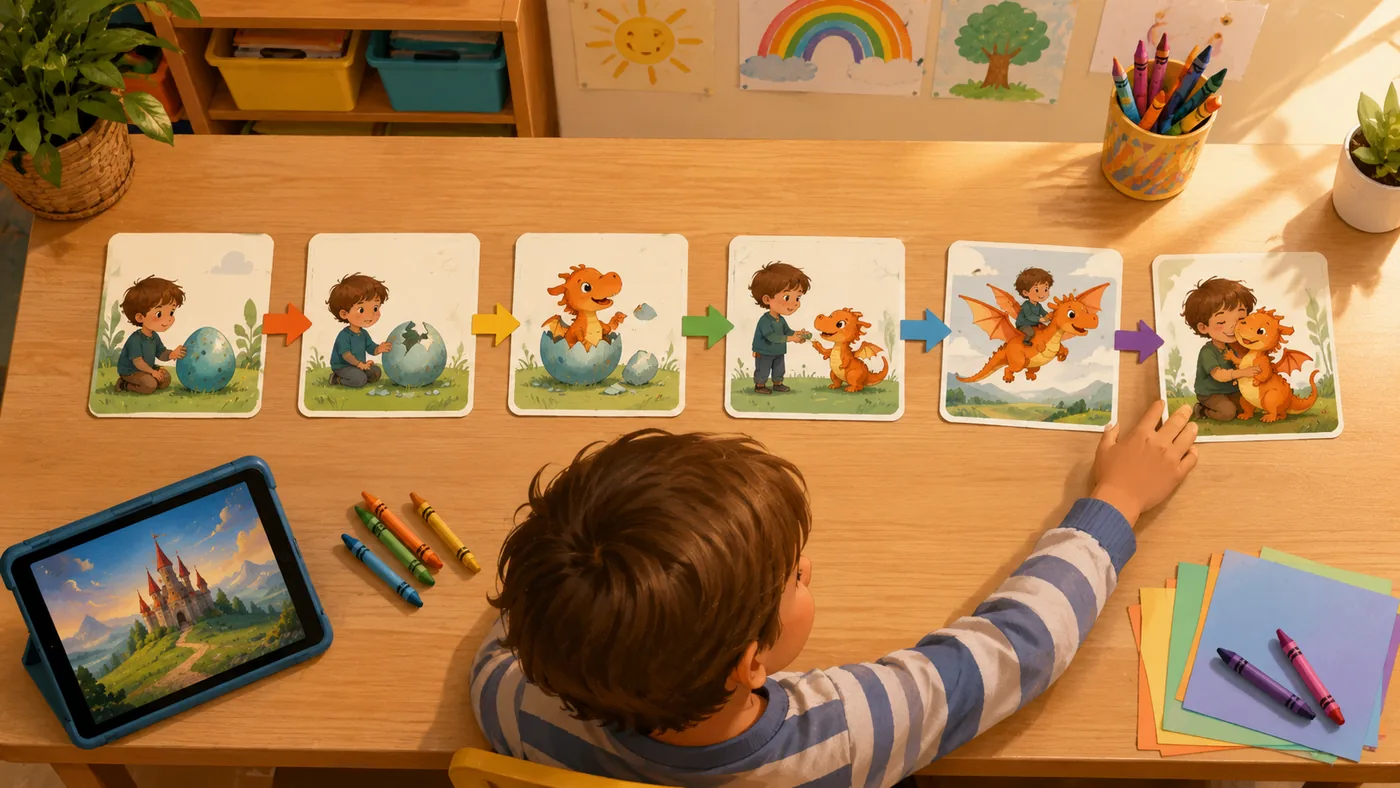
Storyboards Turn Imagination into Order
An ai storyboard generator can do more than create attractive pictures. Used well, it can help children practice one of the most important early thinking skills: putting events in order. Young children often have vivid ideas, but those ideas arrive all at once. A dragon, a lunchbox, a cloud, and a bicycle may all appear in the same sentence. The adult's job is not to correct the imagination away. The job is to help the child organize it.
This is where TaleHug's storybook format is useful. Each page asks a hidden logic question: what happens now? The child sees that a story is not just a pile of fun objects. It is a path. A character begins somewhere, notices a problem, tries something, learns something, and arrives at a small resolution.
That page-by-page structure makes abstract logic visible.
First, Next, Then, Finally
Early logic often begins with simple sequencing words. Before children can analyze complex arguments, they learn to say "first," "next," "then," and "finally." A storyboard gives those words a visual anchor. Page one can show the character before the problem. Page two can show the first attempt. Page three can show a surprising result. Page four can show a calmer ending.
TaleHug supports this by turning a prompt or drawing into a compact picture-first draft. A parent might start with: "A little fox wants to build a bridge across a puddle." The draft can then become a conversation:
- First, what does the fox notice?
- Next, what material does the fox try?
- Then, what goes wrong?
- Finally, how does the fox solve it?
This is not a worksheet. It is a story. That matters because children often practice reasoning more willingly when the reasoning is inside play.